From Pre-Contact to Shatter Zone: Exploring Florida Cultural Legacies
was an exhibition project in the University of Miami Richter Library during 2022. The exhibit explored the legacies of Southeastern Indigenous cultures that emerged in the 10th century of the current era and the Franciscan missionary enterprise that ended in the mid-18th century. We have created an online version of the exhibition to provide a framework for further investigation.
700-1560 C.E.
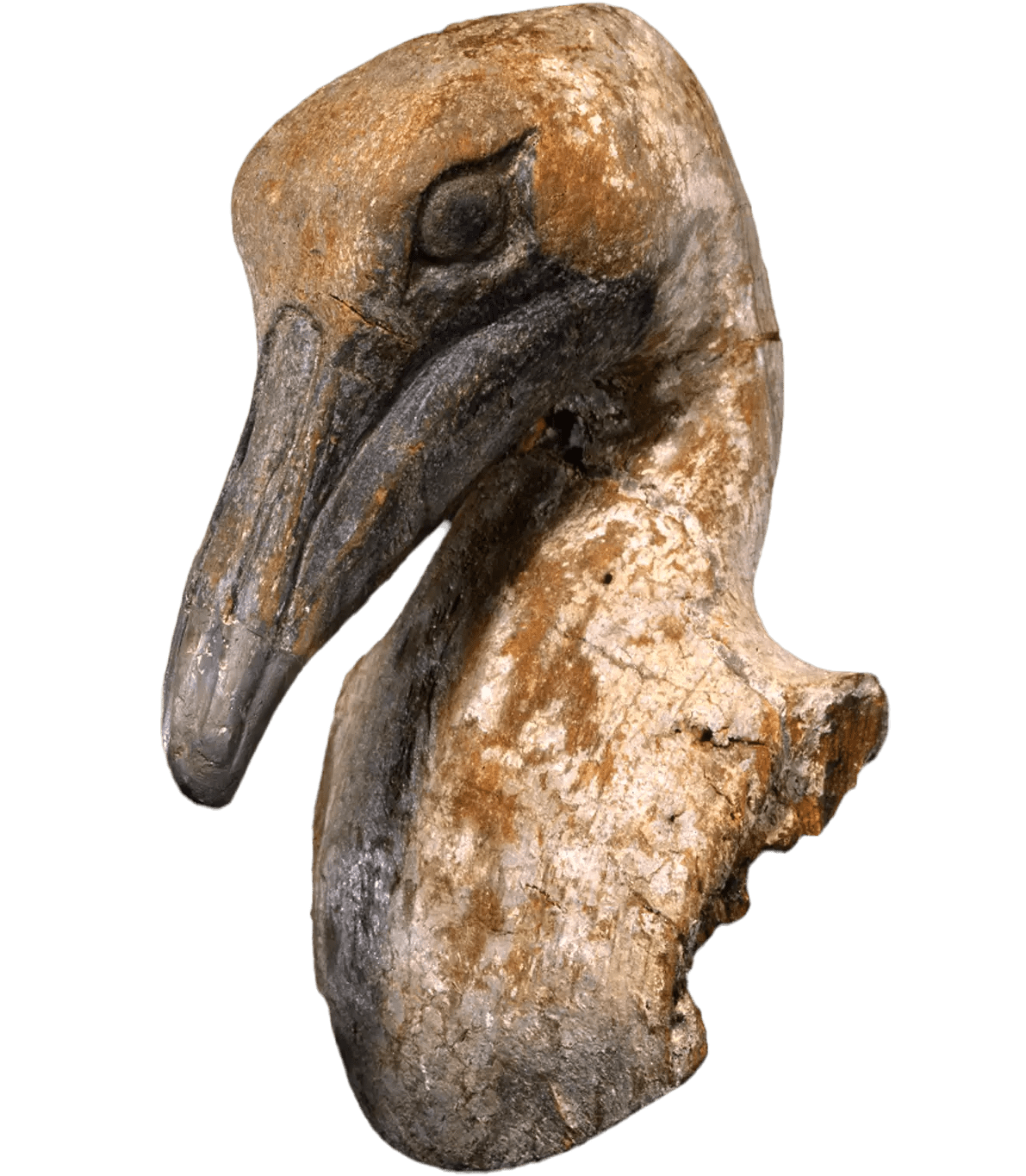
The exhibition begins with a selection of artistic artifacts from the Mississippian period. Characterized by a vigorous economy based on maize agriculture and other staples, this rich period gave rise to highly complex, stratified polities extending across vast regions of midwestern and southeastern Turtle Island or of present-day United States. The economic, political, and ritual power accumulated by Mississippian elites fostered the production of sophisticated art objects and symbols that displayed their status and circulated in wide exchange networks comprising major ceremonial and mound centers such as Cahokia in Illinois, Spiro in Oklahoma, Moundville in Alabama, Etowah in Georgia, Lake Jackson in northwest Florida, reaching Key Marco in the Gulf coast.
Although the scale, influence and strength of these Mississippian ceremonial centers and other densely populated villages in their vicinities rose and fell over the centuries, by the time of contact in the 1500’s the French and the Spaniards interacted with distinct Indigenous communities governed by hereditary chiefs deploying conspicuous prestige goods and protocols that evinced their power to mobilize abundant human and material resources.
The Indigenous peoples in Florida that interacted most closely with the Spaniards were the Guale, the Timucua and the Apalachee. The Guale lived along the northern Georgia coast and barrier islands. At the time of contact they were organized into approximately six chiefdoms. The Guale had been mound builders and spoke a distinctive Muskogean language. Like their neighbors in the south, Guale sustenance was based on fishing, hunting, foraging wild fruits and farming plant foods. The Timucua flourished in southeast Georgia and northeast coastal and northern inland Florida. Although never forming a paramount chiefdom or a major political unit, they were distributed in approximately thirty-five small scale or simple chiefdoms comprising communities that spoke at least ten dialect variations of the Timucua language, and which occasionally integrated into higher regional formations. Like most hierarchical Southeastern Indigenous societies, the Timucua were organized according to a matrilineal kinship system under the authority of a hereditary chief belonging to his mother’s clan. The third peoples from La Florida who engaged most intimately with the Spaniards were the Apalachee. They inhabited the compact northwestern region of inland Florida between the Ochlockonee and Aucilla Rivers stretching north to the Georgia border and south to the Gulf of Mexico. The Apalachee were skilled horticulturalists and had formed part of the sophisticated, pre-contact Mississippian cultural network. They spoke Apalachee, another Muskogean language. Well-known for their wealth and military prowess since pre-contact times, the Apalachee had perhaps the most complex socio-political formation in La Florida when the Spanish showed up in the early 1500’s.
After many setbacks and misfires, the Spaniards finally established St. Augustine in 1565, which became the first permanent European settlement in present day United States. Perceived as a new local power to contend with, many highly ranked regional chiefs in the region came to the intrusive garrison to request alliance with the Spanish king. While conversion to Christianity was not required, caciques saw the expediency of having missions in their towns. The presence of friars increased Native lobbying and trade leverage with the Spaniards and augmented the influence of chiefs among neighboring polities in a changing world. Indeed, even in the face of deteriorating conditions, Indigenous chiefs in La Florida held fast to their ancestral matrilineal political and social institutions for two hundred years after the uninvited European arrival to their lands.
Tragically, La Florida missions became shatter zones triggered by contact with the Spanish, their exploitation of Indigenous labor, drastic population losses due to epidemics, and the final destruction of the missions brought about by the English and their Indigenous non-missionized allies. And yet, with renewed understandings of early modern Native American transcultural competencies, the stories of this undoubtedly violent period keep calling out for efforts to address the missions not only as theaters of ruination and cultural loss. They demand to consider them also as complex, multicultural and multiethnic sites where Indigenous people acted resolutely and with keen advertence as they braved spaces of unprecedented and invasive global connectivities. To hear and pursue this agency is an important trend in contemporary European-Indigenous studies in early modern Florida. The second part of this exhibition is a contribution to this effort, displaying objects from the missions that evince high levels of literacy and sophisticated transcultural activity by polyglot Timucua linguists and grammarians, who were major actors in forging the legacy of the first Native American language recorded in present day United States. By delving in this legacy, we are witnessing the presence of authoritative Timucua voices as they wielded their own interpretations, views, and versions of the exotic doctrines of Catholic Christianity.
 Exploring Florida Cultural Legacies